Digital Taylorism and The Productivity Trap
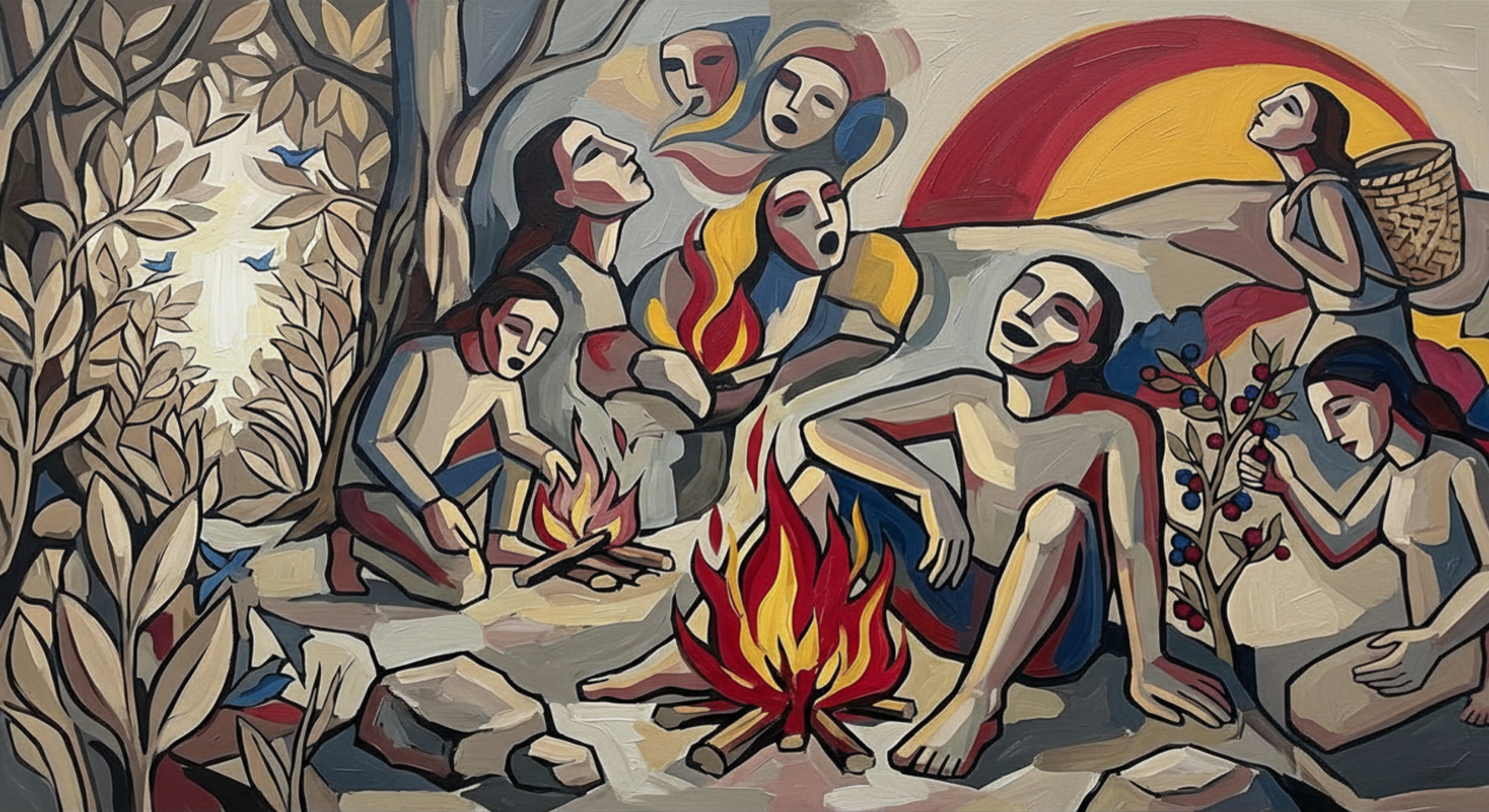
One day you wake up, and the sound you hear isn’t an alarm; you’re mistaken. It’s the chirping of birds, pale morning light filtering through the leaves, and the whisper of the wind. Welcome, you are now tens of thousands of years in the past. Your first job is probably checking the fire, just like you have to do almost every single day to stay alive. As usual, no one else is going to check that fire for you; it’s your responsibility. While doing that, you smell the air and try to figure out entirely by instinct which animals visited your area during the night. After finishing your daily routines, you put your basket on your back and start a long walk to gather wild berries, one of summer’s best gifts. When the trip is over, you carefully pick the fruits and put them in your basket, making sure the branches can bloom again next year. By reading the sun’s curve in the sky, you decide when to head back. Your fire is burning, your stomach is full. And right at that moment, you feel an indescribable sense of satisfaction because you are standing at a very pure point in your existence.
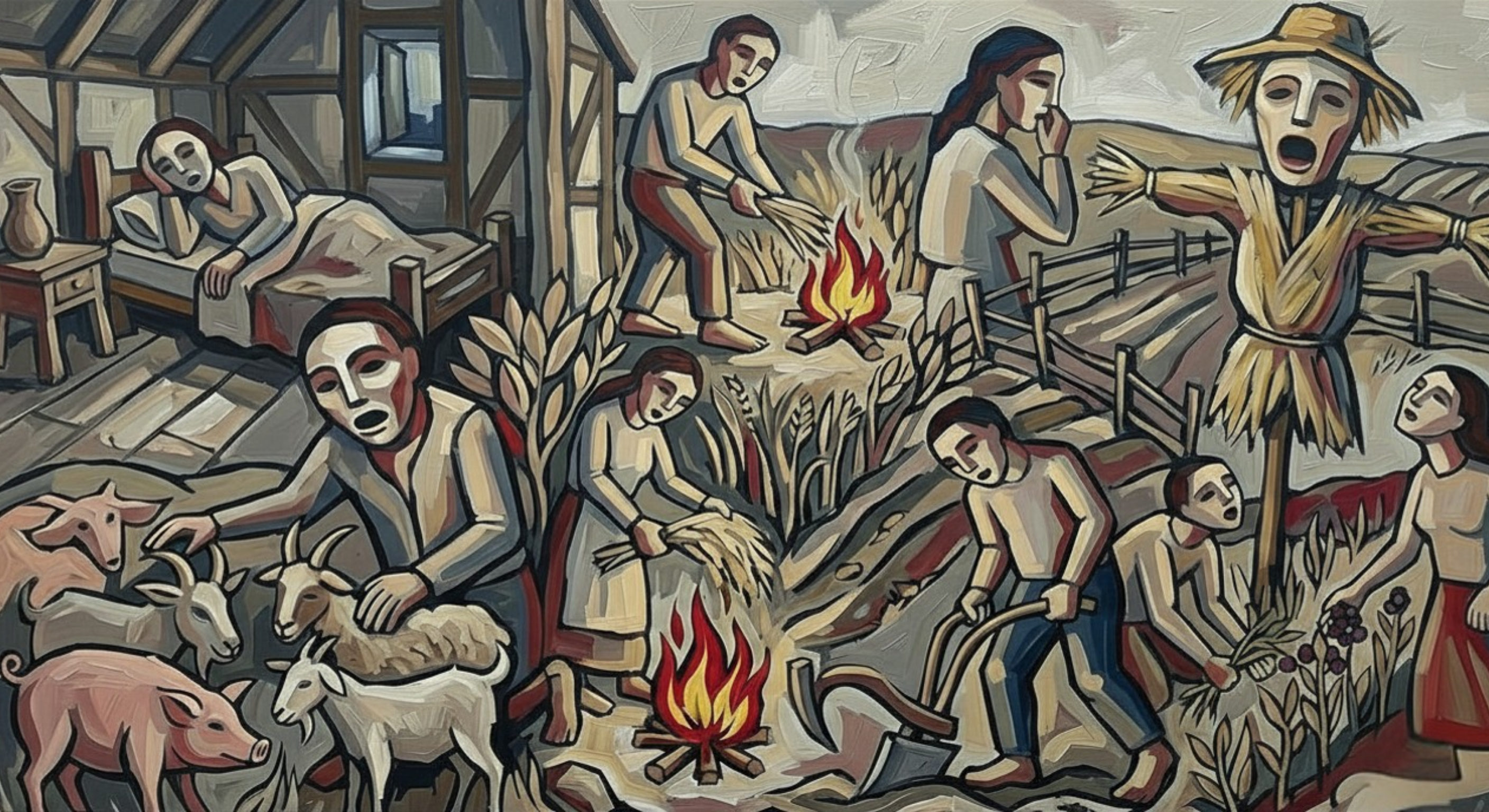
500 years ago, you wake up again, and where you sleep is probably a bit more comfortable. Less sunlight gets inside, and you have a sheltered, personal space that we can actually call a “home.” You open your eyes early in the morning. No need to prepare for a long journey; you can handle those “routine” yet “vital” tasks close by, just like you do most days. You step outside and start the day by checking your animals and the crops you planted. You look over your fields to see if the fences you built for “protection” are still standing and if your “scarecrows” actually scare anything away. Now it’s time for the seasonal tasks you do almost every day: threshing, plowing, pulling weeds. These tasks bring zero value to the world as a whole, but they are entirely for your own survival and livelihood. You don’t even know how “sustainable” your work is in the modern sense; you just know to do it, and you keep doing it.
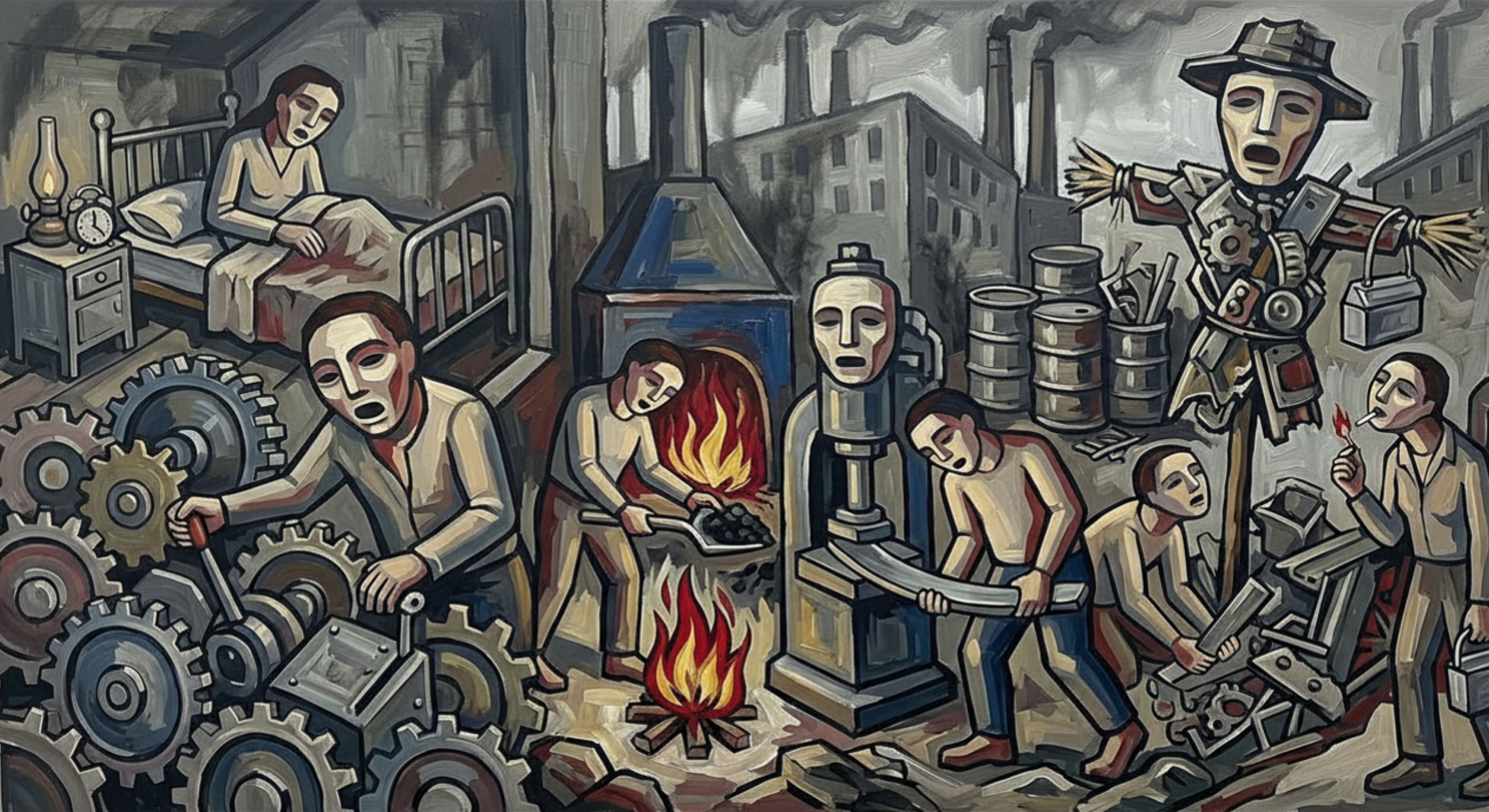
100 years ago, you open your eyes to another day, but this time not enough sunlight is getting in. Plus, you didn’t wake up naturally. A simple metal mechanism was making a highly annoying noise. You need to get out of bed immediately because your struggle to survive no longer depends on nature’s mercy, but on the gears of an industry. When you put on your coat and take your first step outside, your eyes squint a bit. A while later, you arrive at your destination under huge gray buildings and soot-filled chimneys, accompanied by the smell of coal and people sharing the same fate. Since there was still a bit of time before your shift, you seek comfort in a different shade of gray. You light a cigarette from your pocket and celebrate that tiny, fleeting “me time” of the day. Your shift begins, and you continue bending the steel given to you by someone else, at the exact same angle on the exact same press, just like you’ve done for years. Some small updates come to your job over the years, but the concept of mastery is slowly dying. In spite of all this, congratulations: you have a longer lifespan compared to 400 years ago. This long life is quite important so you can remain an efficient gear on the production line.
The First Time I Stopped
I woke up on a day where exciting innovations are moving at an unimaginable speed, and people on LinkedIn and X share content every morning shouting about a “New Revolution!” A comfortable bed, a well-calculated breakfast, and my preferred morning supplements were waiting for me. While getting ready, I realized the billion-dollar dominance wars between massive tech companies had turned into a silly game of chess, so I opted for a much calmer podcast in the background. Now I could start my shift. I didn’t have to travel long distances to an office every day; I was working from home as a digital worker.
Using the AI tools my company provides, I was summarizing global news, sorting my unread emails, and planning out my day in the early morning hours. Just a few hours into work, I found myself in this exact position: While brainstorming a complex system I was working on with one AI assistant, I was using another one to write infrastructure code (IaC) in minutes just to test a cloud architecture idea that would normally take weeks to build. At the very same time, completely in the background, I was developing another agent to automate a tiring documentation process I normally had to do manually.
It felt like every friction surface between my mind and the digital world had completely melted away. I was turning ideas into reality at a pure, smooth, and dizzying speed. But something was off. The end of manual processes had also taken away that pure feeling of satisfaction I used to get from producing.
The Digital Illusion
The only thing endless speed gives us is that indescribable feeling of emptiness we get from running faster toward the horizon but never reaching it.
In that moment, an instant realization hit me. I took my hands off the keyboard and stopped.
That day, for the first time in a long while, I actually stopped.
I remember very well the feeling I had right before I stopped. Am I efficient enough? Am I missing out on that new language, or this new model? There are so many things I planned to learn, and I just can’t make the time for them. If I had to sum up the feeling created by these sentences and questions, I felt like a horseback rider desperately trying to catch the horizon. The horse beneath me is stronger than ever, the wind of the latest technology blows from behind, and the road ahead is a blur of speed. But no matter how fast I go, the horizon moves away at the same speed. I can never reach it.
The first thing that came to my mind when I stopped was my early career days. I was doing freelance Android app development. I was a student, and there was an endless ocean of knowledge to learn and improve upon (I still feel the same way). I spent one entire day just trying to build a simple welcome animation (splash screen) exactly the way I wanted and imagined it. When I finally captured the animation I dreamed of at the end of the day, what I felt was pure satisfaction, and the thought that came to my mind was how productive my day had been. Right now, I can do the exact same thing in minutes with an AI tool, but I don’t think I’ll feel that same satisfaction and fall into the same thoughts. This was exactly what popped into my head. Then some questions naturally followed: What is playing with our productivity settings? Why is it so variable, why is productivity a horizon line for us? Is productivity the same for everyone?
How did our desire to do more turn us into machines that just optimize processes? What was actually lying at the roots of humanity’s “productivity” obsession?
Pro-ducere: Moving Forward
I believe that what a concept deeply means to us is directly connected to our historical relationship with that word. If we look at the epistemology of the concept of productivity:
Word Origin
The word productivity comes from the Latin verb “pro-ducere”. It is born from Pro (Forward) and ducere (To lead). At its core, it doesn’t just mean to produce; it means to move us forward toward our values, roots, and true purpose.
When we measure our productivity in daily life or use productivity tools, our main goal, whether we realize it or not, is to move forward. But what do we really mean by moving forward? Doesn’t time constantly carry us forward anyway? Before we find an answer to this massive question, we need to understand the goals of the people who first tried to define the concept of productivity.
The word Productivity was first used in a 1766 article by French economist Francois Quesnay. He used it to express the difference between the seed planted in the soil (input) and the crop harvested (output). In its simplest form, this was the ratio between output and input; it is the ancestor of the ROI (Return on Investment) concept that is the holy grail of the IT world. Of course, as our goals and the things that move us forward changed shape over the years, the fields where we applied this concept changed as well.
Taylor’s Shovel
In 1911, a mechanical engineer named Frederick Taylor published a book. The name of the book was The Principles of Scientific Management. This book basically claimed that the intuitive work done by each worker through trial and error was just an “Information Chaos.” In this information chaos, data was passed completely from master to apprentice, and every master had different work methods and completion times. This made it difficult to measure the relationship between input and output, keeping the ability to predict and maximize the output/input ratio very limited. The purpose of this book was to replace the intuitive work passed from master to apprentice with the scientific method.
Taylor’s most famous story is the shovel experiment he performed at the Bethlehem Steel plant. Taylor introduced the problem like this: “How much load should a worker take on his shovel so that he carries the highest total weight at the end of the day without breaking down?”
The scientific method worked step by step:
Observation stage:
- Workers brought their own shovels.
- Some carried around 4 pounds of coal with a shovel, while others carried 30 pounds of iron ore.
Experiment Stage:
- Different weights were tested. If they took too much, the workers got tired quickly. If they took too little, they walked a lot and did little work.
Discovery Stage:
- He mathematically found that the ideal load was exactly 21 pounds (about 9.5 kg).
Execution Stage:
- A shovel standard was brought to the factory. Separate shovels were made for coal and iron, and the work output of 500-600 people started to be achieved by 140 people. Productivity went up and costs dropped.
As a mechanical engineer, Taylor had created human machines. Naturally, the workers hated him. It even caused him to give testimony before the US Congress through some labor unions. But Capitalism, of course, embraced Taylor.
It is a fact that our living conditions have improved as the calendar pages flipped and years passed. We breathe less coal, we can take more supplements, and we can eat healthier. At least the number of people who have access to these facilities in the world is higher than in previous periods. But right here, a bitter paradox of modernity sticks to us. On the one hand, we complain about Taylorism and becoming machines, but on the other hand, we rush full speed ahead to consume more and seem to have more facilities.
The Jevons Paradox
This dual separation actually has a very specific name in ecological economics:
The Jevons Paradox
When the usage efficiency of a resource increases, because the unit cost drops, the total consumption (and the appetite for that resource) does not decrease as expected; on the contrary, it increases. (William Stanley Jevons, 1865)
Let’s explain this with a simple example from technology history. Imagine a factory making phone parts. Assume that in the early days, we could produce 1000 phones with a limited capacity, slowly and with difficulty. We set up the assembly line, broke down the operations, and “optimized” the production. The factory was now able to do the same amount of work by using 30% of energy and effort. Logically, wouldn’t it be expected that some of the machines would be turned off? Never. The lights of that factory burned until much later hours. Because the goal was not to consume less energy, but to produce phones in much higher numbers instead of 1000 with the same energy.
This paradox tells us two things. Taylorism increased production efficiency, and naturally, the number of produced goods increased. Because the number of products increased, the facilities that we called impossible and that very few people could reach turned into something that many people could reach due to the abundance of products. Secondly, the increase in people’s annual earnings became a necessity for states to grow their capital. The summary of these two points means that this is not a blessing given to us individuals; it means that the B2C market is an incredibly important food source for capital.
The Rider on the Horizon and AI
Taylorism didn’t just stay in production fields, of course. For many years, under the influence of digital Taylorism, white-collar workers are also evaluated with metrics like OKR, KPI, and Timesheets. Their productivity is measured, and tools are provided to increase this. It is very clear that AI will be one of these tools and also one of the tools digital Taylorism uses to measure our productivity.
We can say that the productivity anxieties we experience and the feelings created by the unknown brought by the AI transformation are actually our fears finding a shell. The foundations of our fears are our primitive instincts, but the reasons are just as real.
Maybe the only thing all of humanity understood by “pro-ducere” (moving forward) was not just having more or producing faster, but it should have been moving toward the core values that make us who we are. Taylor’s shovel made the horse under us faster; artificial intelligence now put the wind completely behind us. But the real tragedy is this: No matter how fast our horse goes, the horizon will keep running away from us. As we produce faster, the new horizon line will always be pulled further away.
However, tens of thousands of years ago, when our basket was full, we used to gaze at the sweet calm filtering from the sun’s curve and head straight to our homes; now, instead of returning home, we are desperately trying to figure out how to weave a “bigger basket” imposed by the system.
For thousands of years, our ancestors continued by finding meaning in their lives without doing any of the jobs we fight a life-or-death battle for right now. Our fear is not that artificial intelligence will turn us into a jobless army with no skills; let’s admit this to ourselves. The real feeling we lost in the face of this brutally imposed speed is our right to be satisfied and finally own the finish line.
Our fear lies much deeper, and is far more primitive.